
AsyncAPI Generator for Java / Spring-Boot
Section titled “AsyncAPI Generator for Java / Spring-Boot”

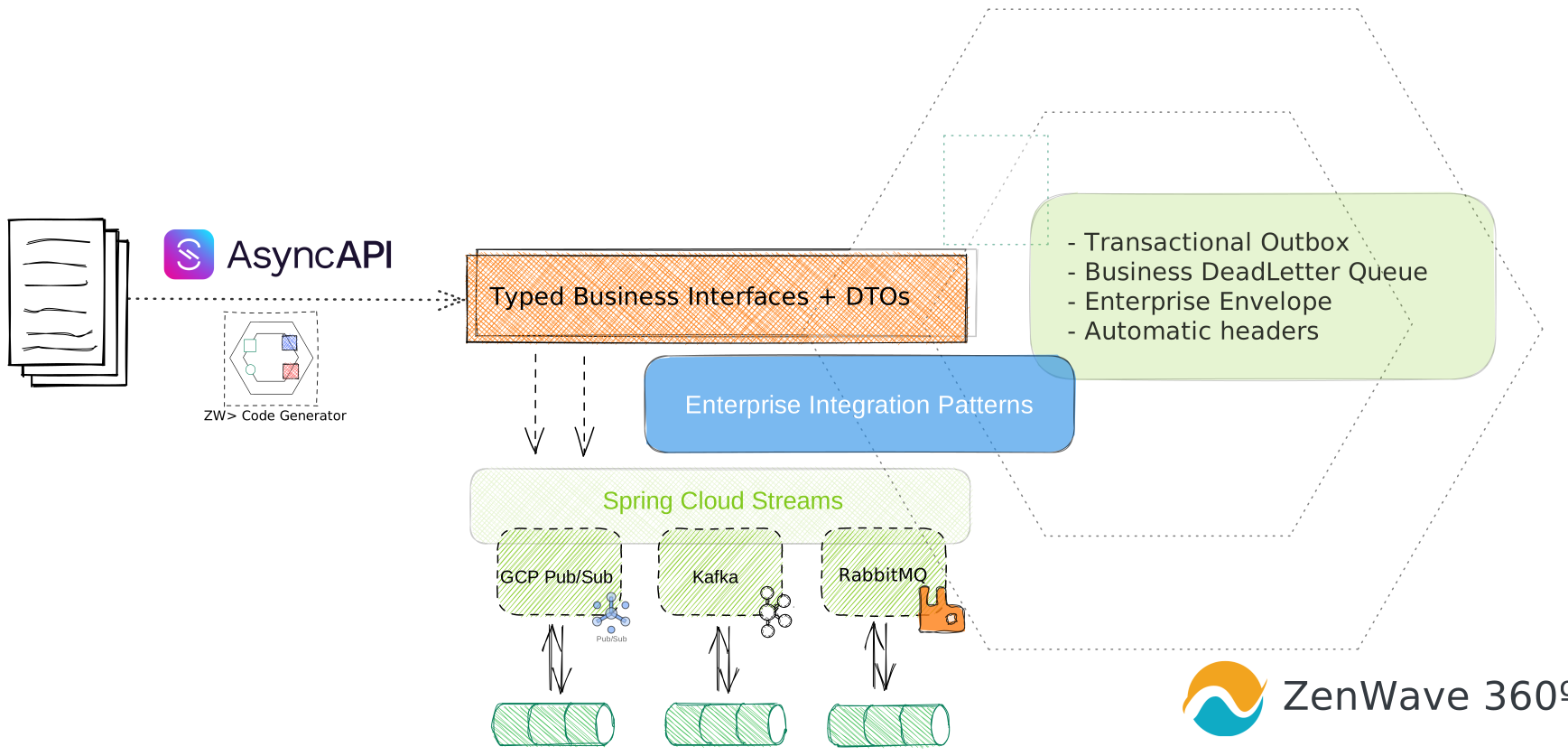
The ZenWave AsyncAPI Generator solves a long-standing issue in event-driven Java applications:
👉 keeping message models and channel contracts fully aligned with their AsyncAPI specification.
It provides build-time read-only code generation from AsyncAPI files sourced from their canonical locations: local files, classpath resources, or authenticated remote URLs.
This approach eliminates API drift by enforcing the AsyncAPI file as the single source of truth for message schemas, channel definitions, and producer or consumer interfaces.
All generated classes are strongly typed and annotated for validation, and any breaking change in the specification results in a compile-time error.
This model aligns with the proven pattern used by the OpenAPI Maven Generator plugin, which solved API drift for OpenAPI in the Java ecosystem, generating non-editable interfaces and DTOs, and ensures contract consistency across consumers and producers.
You just need to focus on implementing your business logic, and configuring either Spring Cloud Streams or Spring Kafka for message transport.
A complete working example is available in the zenwave-playground repository: asyncapi-shopping-cart.
- AsyncAPI Generator for Java / Spring-Boot
Features
Section titled “Features”Generated Code
Section titled “Generated Code”- Complete Producer and Consumer implementations for Java and Spring Boot with thin wrappers around:
- Spring Cloud Stream for multi-broker support
- Spring Kafka for native Kafka integrations
- JSON DTOs generated via jsonschema2pojo library
- Avro DTOs generated via Apache Avro library
For selected messages, jsonschema2pojo generates payload models by default. Object schemas declared on those messages are opt-in and off by default: set generateMessageKeys=true for message binding keys (e.g. Kafka keys), generateMessageHeaders=true for application headers declared on messages or inherited from message traits, and generateBindingHeaders=true for protocol binding header schemas (HTTP/JMS/MQTT).
Supported Capabilities
Section titled “Supported Capabilities”- AsyncAPI v2 and v3
- Local files, classpath files, and authenticated remote URLs
- DTO generation for JSON Schema and Avro
- Automatic Avro schema ordering for Avro versions prior to 1.12.0
- Strongly typed header objects from AsyncAPI message definitions
Advanced Patterns
Section titled “Advanced Patterns”- Transactional Outbox pattern using Spring Modulith
- Role reversal to generate only the side you need (provider or client)
- Operation-level filtering for selective interface generation
- Automatic header mapping at runtime through the
x-runtime-expressionextension
Quick Configuration
Section titled “Quick Configuration”Use these essential configuration options to get the generator running quickly:
- inputSpec: Path or URL for the AsyncAPI specification
- role:
provider(default) orclient - templates:
SpringCloudStream(default) orSpringKafka - modelPackage: Java package for generated DTOs (required for JSON Schema)
- producerApiPackage: Java package for producer interfaces (provider role)
- consumerApiPackage: Java package for consumer interfaces (client role)
- avroCompilerProperties.imports: Comma-separated Avro files or folders
- operationIds: Filter to generate only selected operations
- authentication: Credentials for authenticated remote AsyncAPI files
Advanced customization is available through:
- avroCompilerProperties.xxx: Settings passed to the underlying Avro compiler
- jsonschema2pojo.xxx: Settings passed to jsonschema2pojo
Why ZenWave doesn’t source Spring Cloud Stream / Spring Kafka config from AsyncAPI
Section titled “Why ZenWave doesn’t source Spring Cloud Stream / Spring Kafka config from AsyncAPI”ZenWaveSDK provides all the building blocks to prevent API drift, keeping your source code aligned with your AsyncAPI specification. But it does not attempt to auto-configure Spring Cloud Stream or Spring Kafka from the AsyncAPI file.
While configuring Spring Cloud Stream or Spring Kafka from AsyncAPI would be convenient, it is not currently feasible.
AsyncAPI, even with specific bindings like Kafka bindings, does not yet provide enough information to fully configure Spring Kafka or Spring Cloud Stream:
- no standard fields for
acks,transaction.id,idempotence, and similar settings - Avro SerDes configuration is too ambiguous to infer automatically
- Kafka bindings define
clientIdandconsumerGroupIdper operation, although these are typically application-wide - you can configure a schema registry endpoint but not compatibility modes (BACKWARD, FORWARD, etc.) for subjects or topics
This is why ZenWave does not attempt full auto-configuration from AsyncAPI. The specification is not expressive enough for these frameworks.
Still, this is a one-time operation that belongs in your Spring configuration files, where it can be controlled explicitly, versioned with your application, and tuned independently from your AsyncAPI contract.
Command Line Usage
Section titled “Command Line Usage”jbang zw -p AsyncAPIGeneratorPlugin \
authentication[0].key=API_KEY \
authentication[0].value=API_KEY_VALUE \
apiFile=https://raw.githubusercontent.com/ZenWave360/zenwave-playground/refs/heads/main/examples/asyncapi-shopping-cart/apis/asyncapi.yml \
consumerApiPackage=io.example.api.consumer \
producerApiPackage=io.example.api.producer \
modelPackage=io.example.api.model \
avroCompilerProperties.imports="\
https://raw.githubusercontent.com/ZenWave360/zenwave-playground/refs/heads/main/examples/asyncapi-shopping-cart/apis/avro/Item.avsc,\
https://raw.githubusercontent.com/ZenWave360/zenwave-playground/refs/heads/main/examples/asyncapi-shopping-cart/apis/avro/ShoppingCart.avsc" \
targetFolder=target/generated-sourcesOverlays
Section titled “Overlays”Use apiOverlayFiles to patch the AsyncAPI source before dereferencing and allOf merge.
jbang zw -p AsyncAPIGeneratorPlugin \
  apiFile=src/main/resources/asyncapi.yml \
  apiOverlayFiles=src/main/resources/asyncapi-overlay.yml \
  modelPackage=io.example.api.model \
  producerApiPackage=io.example.api.producer \
  consumerApiPackage=io.example.api.consumer \
  targetFolder=target/generated-sources
Overlay files are applied in order. This is intended for local files and file-backed classpath: resources.
Maven Usage
Section titled “Maven Usage”Properties Configuration
Section titled “Properties Configuration”<properties>
<asyncapiPrefix>classpath:io/example/asyncapi/shoppingcart/apis</asyncapiPrefix>
<asyncapi.inputSpec>${asyncapiPrefix}/asyncapi.yml</asyncapi.inputSpec>
<asyncapi.avro.imports>
${asyncapiPrefix}/avro/
</asyncapi.avro.imports>
<zenwave.asyncapiGenerator.templates>SpringKafka</zenwave.asyncapiGenerator.templates>
<asyncApiProducerApiPackage>${basePackage}.events</asyncApiProducerApiPackage>
<asyncApiConsumerApiPackage>${basePackage}.commands</asyncApiConsumerApiPackage>
</properties>Plugin Configuration
Section titled “Plugin Configuration”<plugin>
<groupId>io.zenwave360.sdk</groupId>
<artifactId>zenwave-sdk-maven-plugin</artifactId>
<version>${zenwave.version}</version>
<configuration>
<inputSpec>${asyncapi.inputSpec}</inputSpec>
<skip>false</skip>
<addCompileSourceRoot>true</addCompileSourceRoot>
<addTestCompileSourceRoot>true</addTestCompileSourceRoot>
<authentication>
<authentication>
<key>API_KEY</key>
<value>XXXXXX</value>
</authentication>
</authentication>
</configuration>
<executions>
<execution>
<id>generate-asyncapi</id>
<phase>generate-sources</phase>
<goals>
<goal>generate</goal>
</goals>
<configuration>
<generatorName>AsyncAPIGenerator</generatorName>
<configOptions>
<role>provider</role>
<templates>${zenwave.asyncapiGenerator.templates}</templates>
<modelPackage>${asyncApiModelPackage}</modelPackage> <!-- required only for json-schema, otherwise it uses avro package -->
<producerApiPackage>${asyncApiProducerApiPackage}</producerApiPackage>
<consumerApiPackage>${asyncApiConsumerApiPackage}</consumerApiPackage>
<avroCompilerProperties.imports>${asyncapi.avro.imports}</avroCompilerProperties.imports><!-- comma separated list of avro files or folders -->
</configOptions>
</configuration>
</execution>
</executions>
<dependencies>
<dependency>
<groupId>io.zenwave360.sdk.plugins</groupId>
<artifactId>asyncapi-generator</artifactId>
<version>${zenwave.version}</version>
</dependency>
</dependencies>
</plugin>Note on Avro:
asyncapi-generatoralways includes Avro compilation support in its generation chain, even for JSON-Schema-only specifications, soorg.apache.avro:avro-compileris a regular (compile-scope) dependency of the artifact and is resolved automatically — you don’t need to declare it yourself. Its transitivejackson-core/jackson-databindare excluded to avoid conflicting with the Jackson version managed by your own project/Spring Boot BOM. If you need a different Avro version, override it via<dependencyManagement>in your POM rather than redeclaring the dependency here.
Gradle Usage
Section titled “Gradle Usage”val asyncapiPrefix = "classpath:io/example/asyncapi/shoppingcart/apis"
val asyncapiInputSpec = "$asyncapiPrefix/asyncapi.yml"
val asyncapiAvroImports = "$asyncapiPrefix/avro/"
val asyncapiGeneratorTemplates = "SpringKafka"
val asyncApiProducerApiPackage = "io.zenwave360.examples.events"
val asyncApiConsumerApiPackage = "io.zenwave360.examples.commands"
plugins {
java
id("dev.jbang") version "0.3.0"
}
tasks.register<dev.jbang.gradle.tasks.JBangTask>("generateAsyncApiProvider") {
group = "asyncapi"
description = "Generates Producer and Consumer code from AsyncAPI specification"
script.set("io.zenwave360.sdk:zenwave-sdk-cli:RELEASE")
jbangArgs.set(listOf(
"--deps=" +
"org.slf4j:slf4j-simple:1.7.36," +
"io.zenwave360.sdk.plugins:asyncapi-generator:RELEASE," +
"org.apache.avro:avro-compiler:1.11.1"
))
args.set(listOf(
"-p", "AsyncAPIGenerator",
"role=provider",
"templates=$asyncapiGeneratorTemplates",
"apiFile=$asyncapiInputSpec",
"targetFolder=${layout.buildDirectory.dir("generated-sources/zenwave").get().asFile.absolutePath}",
"transactionalOutbox=modulith",
"modelPackage=$asyncApiModelPackage",
"producerApiPackage=$asyncApiProducerApiPackage",
"consumerApiPackage=$asyncApiConsumerApiPackage",
"avroCompilerProperties.imports=$asyncapiAvroImports"
))
}
sourceSets {
main {
java {
srcDir(layout.buildDirectory.dir("generated-sources/zenwave/src/main/java").get().asFile)
}
}
test {
java {
srcDir(layout.buildDirectory.dir("generated-sources/zenwave/src/test/java").get().asFile)
}
}
}Configuring Spring Cloud Stream Bindings
Section titled “Configuring Spring Cloud Stream Bindings”ZenWaveSDK does not derive Spring Cloud Stream bindings from the AsyncAPI specification. Binding configuration must be provided explicitly in your application.yml.
Producing Messages
Section titled “Producing Messages”spring:
cloud:
stream:
bindings:
shopping-cart-channel-out: # AsyncAPI channel name (kebab-case) with the `-out` suffix (no `-0`)
destination: shopping-cart
content-type: application/*+avro
producer:
use-native-encoding: trueConsuming Messages
Section titled “Consuming Messages”spring:
cloud:
stream:
kafka.binder.enable-observation: true
bindings:
shopping-cart-channel-in-0: # AsyncAPI channel name (kebab-case) with the `-in-0` suffix
destination: shopping-cart
group: shopping-cart-groupNote on binding name suffixes: Producer and consumer bindings use different naming conventions. Producers use the binding name exactly as declared (for example, -out), while consumers use the indexed form (-in-0) required by Spring Cloud Stream. The AsyncAPI generator does not append -0 to producer bindings (unlike the legacy SpringCloudStream3Plugin). This behavior is kept for backward compatibility.
Configuring Spring Kafka Bindings
Section titled “Configuring Spring Kafka Bindings”ZenWaveSDK also does not generate Spring Kafka configuration from the AsyncAPI file. Topic and consumer settings must be defined manually in application.yml.
app:
  kafka:
    topics:
      shopping-cart-channel: # AsyncAPI channel name (kebab-case)
        topic: shopping-cart
        groupId: shopping-cart-group            # consumers only
        containerFactory: shopping-cart-container-factory # consumers only
Configuration Options
Section titled “Configuration Options”| Option | Description | Type | Default | Values |
|---|---|---|---|---|
apiFile | API Specification File | URI | ||
apiOverlayFiles | Ordered list of API overlay YAML files applied before dereferencing and allOf merge. | List | [] | |
role | Project role: provider/client | AsyncapiRoleType | provider | provider, client |
templates | Templates to use for code generation. | String | SpringCloudStream | SpringCloudStream, SpringKafka, FQ Class Name |
modelPackage | Java Models package name | String | ||
producerApiPackage | Java API package name for outbound (producer) services. It can override apiPackage for producers. | String | {{apiPackage}} | |
consumerApiPackage | Java API package name for inbound (consumer) services. It can override apiPackage for consumer. | String | {{apiPackage}} | |
apiPackage | Java API package, if producerApiPackage and consumerApiPackage are not set. | String | ||
operationIds | Operation ids to include in code generation. Generates code for ALL if left empty | List | [] | |
excludeOperationIds | Operation ids to exclude in code generation. Skips code generation if is not included or is excluded. | List | [] | |
transactionalOutbox | Transactional outbox type for message producers. | TransactionalOutboxType | none | none, modulith |
jsonschema2pojo | JsonSchema2Pojo settings for downstream library (docs) | Map | ||
generateMessageKeys | Generate POJOs for message binding keys (e.g. Kafka bindings.kafka.key) declared in selected messages. | Boolean | false | |
generateMessageHeaders | Generate POJOs for application headers declared on selected messages or inherited from message traits. | Boolean | false | |
generateBindingHeaders | Generate POJOs for protocol binding header schemas (HTTP/JMS/MQTT) declared in selected messages. | Boolean | false | |
avroCompilerProperties | Avro Compiler Properties | AvroCompilerProperties | See AvroCompilerProperties | |
avroCompilerProperties.sourceDirectory | Avro schema file or folder containing avro schemas | File | ||
avroCompilerProperties.imports | Avro schema files or folders containing avro schemas. It supports local files/folders, classpath: files/folders or https:// file resources. | List | ||
avroCompilerProperties.includes | A set of Ant-like inclusion patterns used to select files from the source tree that are to be processed. By default, the pattern **/*.avsc is used to include all avro schema files. | List | [**/*.avsc] | |
avroCompilerProperties.excludes | A set of Ant-like exclusion patterns used to prevent certain files from being processed. By default, this set is empty such that no files are excluded. | List | ||
avroCompilerProperties.customLogicalTypeFactories | Custom Logical Type Factories | List | ||
avroCompilerProperties.customConversions | Custom Conversions | List | ||
componentPrefix | Prefix used in to reference this component in @Component and application.yml | String | ||
componentSuffix | Suffix used in to reference this component in @Component and application.yml | String | ||
generatedAnnotationClass | Annotation class to mark generated code (e.g. org.springframework.aot.generate.Generated). When retained at runtime, this prevents code coverage tools like Jacoco from including generated classes in coverage reports. | String | ||
authentication | Authentication configuration values for fetching remote resources. | List | [] | |
targetFolder | Target folder to generate code to. If left empty, it will print to stdout. | File | ||
modelNamePrefix | Sets the prefix for model classes and enums | String | ||
modelNameSuffix | Sets the suffix for model classes and enums | String | ||
runtimeHeadersProperty | AsyncAPI extension property name for runtime auto-configuration of headers. | String | x-runtime-expression | |
messageNames | Message names to include in code generation (combined with operationIds). Generates code for ALL if left empty | List | [] | |
sourceFolder | Source folder inside folder to generate code to. | String | src/main/java | |
bindingTypes | Binding names to include in code generation. Generates code for ALL bindings if left empty | List | ||
avroFiles | List of avro schema files to generate code for. It is alternative to sourceDirectory and imports. | List | ||
skipProducerImplementation | Generate only the producer interface and skip the implementation. | boolean | false | |
exposeMessage | Whether to expose underlying spring Message to consumers or not. | boolean | false | |
useEnterpriseEnvelope | Include support for enterprise envelop wrapping/unwrapping. | boolean | false | |
envelopeJavaTypeExtensionName | AsyncAPI Message extension name for the envelop java type for wrapping/unwrapping. | String | x-envelope-java-type | |
methodAndMessageSeparator | To avoid method erasure conflicts, when exposeMessage or reactive style this character will be used as separator to append message payload type to method names in consumer interfaces. | String | $ | |
consumerPrefix | Consumer object class name prefix | String | ||
consumerSuffix | Consumer object class name suffix | String | Consumer | |
consumerServicePrefix | Business/Service interface prefix | String | I | |
consumerServiceSuffix | Business/Service interface suffix | String | ConsumerService | |
formatter | Code formatter implementation | Formatters | palantir | palantir, spring, google |
skipFormatting | Skip java sources output formatting | boolean | false | |
haltOnFailFormatting | Halt on formatting errors | boolean | true |
Advanced Features
Section titled “Advanced Features”Transactional Outbox Pattern
Section titled “Transactional Outbox Pattern”ZenWave SDK supports sending messages transactionaly using the Transactional Outbox Pattern.
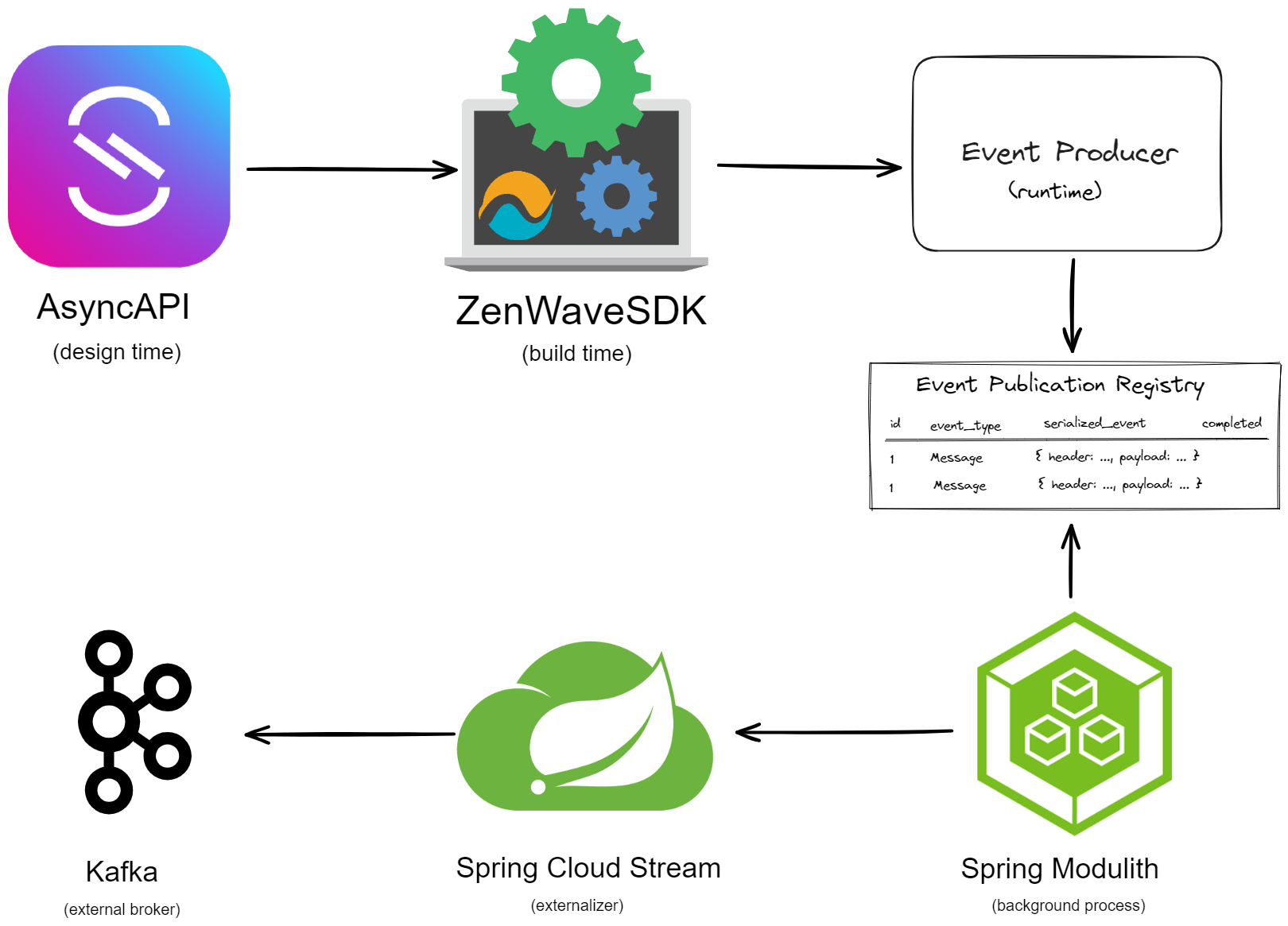
See Implementing a Transactional OutBox With AsyncAPI, SpringModulith and ZenWaveSDK for complete details.
Populating Headers at Runtime Automatically
Section titled “Populating Headers at Runtime Automatically”ZenWave SDK provides x-runtime-expression for automatic header population at runtime. Values for this extension property are:
$message.payload#/<json pointer fragment>: follows the same format as AsyncAPI Correlation ID object.$message.payload#{ <SpEL expression> }: will use the SpEL expression to populate the header value.$supplierBeanName: will use a bean namedsupplierBeanName(you can use any other name) of typejava.function.Supplierconfigured in your Spring context.
    CustomerEventMessage:
      name: CustomerEventMessage
      // [...] other properties omitted for brevity
      headers:
        type: object
        properties:
          kafka_messageKey:
            type: string
            description: This one will be populated automatically at runtime
            x-runtime-expression: $message.payload#/customer/id
          tracingId:
            type: string
            description: This one will be populated automatically at runtime
            x-runtime-expression: $supplierBeanName
          # CloudEvents Attributes:
          # these examples showcase how you can use SpEL expressions to populate runtime headers
          ce-id:
            type: string
            description: Unique identifier for the event
            x-runtime-expression: $message.payload#{#this.id}
          ce-source:
            type: string
            description: URI identifying the context where event happened
            x-runtime-expression: $message.payload#{"CustomersService"}
          ce-specversion:
            type: string
            description: CloudEvents specification version
            x-runtime-expression: $message.payload#{"1.0"}
          ce-type:
            type: string
            description: Event type
            x-runtime-expression: $message.payload#{#this.getClass().getSimpleName()}
          ce-time:
            type: string
            description: Timestamp of when the event happened
            x-runtime-expression: $message.payload#{T(java.time.Instant).now().toString()}
You can also override the runtimeHeadersProperty extension property name (in the rare case you need to):
<configOption>
    <runtimeHeadersProperty>x-custom-runtime-expression</runtimeHeadersProperty>
</configOption>
And provide a bean of type java.function.Supplier in your Spring context:
    @Bean("supplierBeanName")
    public Supplier supplierBeanName() {
        return () -> "some-value";
    }
InMemory Events Producer for Tests (Mocks)
Section titled “InMemory Events Producer for Tests (Mocks)”ZenWave SDK generates an in-memory producer implementation for testing, allowing you to capture messages sent during a test without a real broker.
// autogenerated in: target/generated-sources/zenwave/src/test/java/.../InMemoryCustomerOrderEventsProducer.java
public class InMemoryCustomerOrderEventsProducer implements ICustomerOrderEventsProducer {

    protected Map<String, List<Message>> capturedMessages = new HashMap<>();
    public Map<String, List<Message>> getCapturedMessages() {
        return capturedMessages;
    }
    // other details omitted for brevity

    /**
     * CustomerOrder Domain Events
     */
    public boolean onCustomerOrderEvent(CustomerOrderEventPayload payload, CustomerOrderEventPayloadHeaders headers) {
        log.debug("Capturing message to topic: {}", onCustomerOrderEventBindingName);
        Message message = MessageBuilder.createMessage(payload, new MessageHeaders(headers));
        return appendCapturedMessage(onCustomerOrderEventBindingName, message);
    }
}
// autogenerated in: target/generated-sources/zenwave/src/test/java/.../ProducerInMemoryContext.java
public class ProducerInMemoryContext {
public static final ProducerInMemoryContext INSTANCE = new ProducerInMemoryContext();
private CustomerEventsProducerCaptor customerEventsProducerCaptor = new CustomerEventsProducerCaptor();
public <T extends ICustomerEventsProducer> T customerEventsProducer() {
return (T) customerEventsProducerCaptor;
}
}Getting Help
Section titled “Getting Help”jbang zw -p io.zenwave360.sdk.plugins.AsyncAPIGeneratorPlugin --help