
From Architecture Manifest to EventCatalog
The architecture manifest is only an index. This post follows the generator as it loads that file, parses the contracts it points at, and writes an EventCatalog of domains, services, messages, and flows.
From Architecture Manifest to EventCatalog
The Event Catalog generator has a man page now: the command, the options, the templates, and the live pipeline.
This post is about what happens after that command runs.
The input is a zenwave-architecture.yml master file. That file does not contain your OpenAPI paths, your AsyncAPI channels, or your ZDL entities. It only says where those artifacts live and how they sit in the business tree: domain, subdomain, service.
The generator, with zenwave-architecture, follows those pointers, parses each artifact, and writes an EventCatalog content tree. The rest of this post is that projection: which source becomes which catalog page, and how the identifiers are assigned.
The examples come from Arcadia Editions, a fictional public showcase. Treat the generated catalog as a complete walkthrough, not as a product you should depend on.
The projection in one picture
zenwave-architecture.yml
        |
        |  zenwave-architecture
        |    workspace / git / registry
        v
   domains, subdomains, services
   + resolved artifacts
        |
        |-- Markdown docs      -> service page body
        |-- AsyncAPI           -> channels, events, commands, sends
        |-- asyncapi-client    -> receives, consumer evidence
        |-- OpenAPI            -> commands, queries, REST operation
        |-- ZDL                -> entities, logical operations
        |-- ZFL                -> domain flows
        v
   EventCatalog MDX
     domains/{domain}/...
     .../services/{service}/{events|commands|queries|entities}/...
     domains/{domain}/flows/{flow}/
The plugin chain is the same sequence. The loader reads the typed manifest and builds an architecture graph. Processors then enrich each service. The writer replaces the output folder and archives previous versions.
The manifest is the skeleton
Domains, subdomains, and services come from the YAML tree. Their catalog IDs are the explicit id values. If a node omits id, the generator uses a dotted path from the map keys.
domains:
  "orders":
    id: "orders"
    name: "Orders"
    subdomains:
      "checkout":
        id: "orders.checkout"
        services:
          "orders-checkout":
            id: "orders.checkout.orders-checkout"
            repository: "orders-checkout-api"
            docs:
              summary: SUMMARY.md
              content: EVENT_CATALOG.md
              changelog: CHANGELOG.md
            artifacts:
              - type: zdl
                path: "domain-model.zdl"
                version: "0.0.0"
              - type: asyncapi
                path: "asyncapi.yml"
                version: "0.1.1"
              - type: asyncapi-client
                path: "asyncapi-client.yml"
                version: "0.1.1"
              - type: openapi
                path: "openapi.yml"
                version: "0.0.0"
That fragment becomes:
| Catalog page | Path | ID |
|---|---|---|
| Domain | domains/orders/index.mdx | orders |
| Subdomain | domains/orders/subdomains/orders.checkout/index.mdx | orders.checkout |
| Service | .../services/orders.checkout.orders-checkout/index.mdx | orders.checkout.orders-checkout |
Everything else hangs off the service. Child IDs are {service-id}.{local-key}. That is why an event, a command, and an entity from Orders Checkout all start with orders.checkout.orders-checkout..
The service page also embeds the Markdown files listed under docs. The default template concatenates summary, content, and changelog. Those documents are not rewritten as their own catalog types; they become the long-form body under the generated overview.
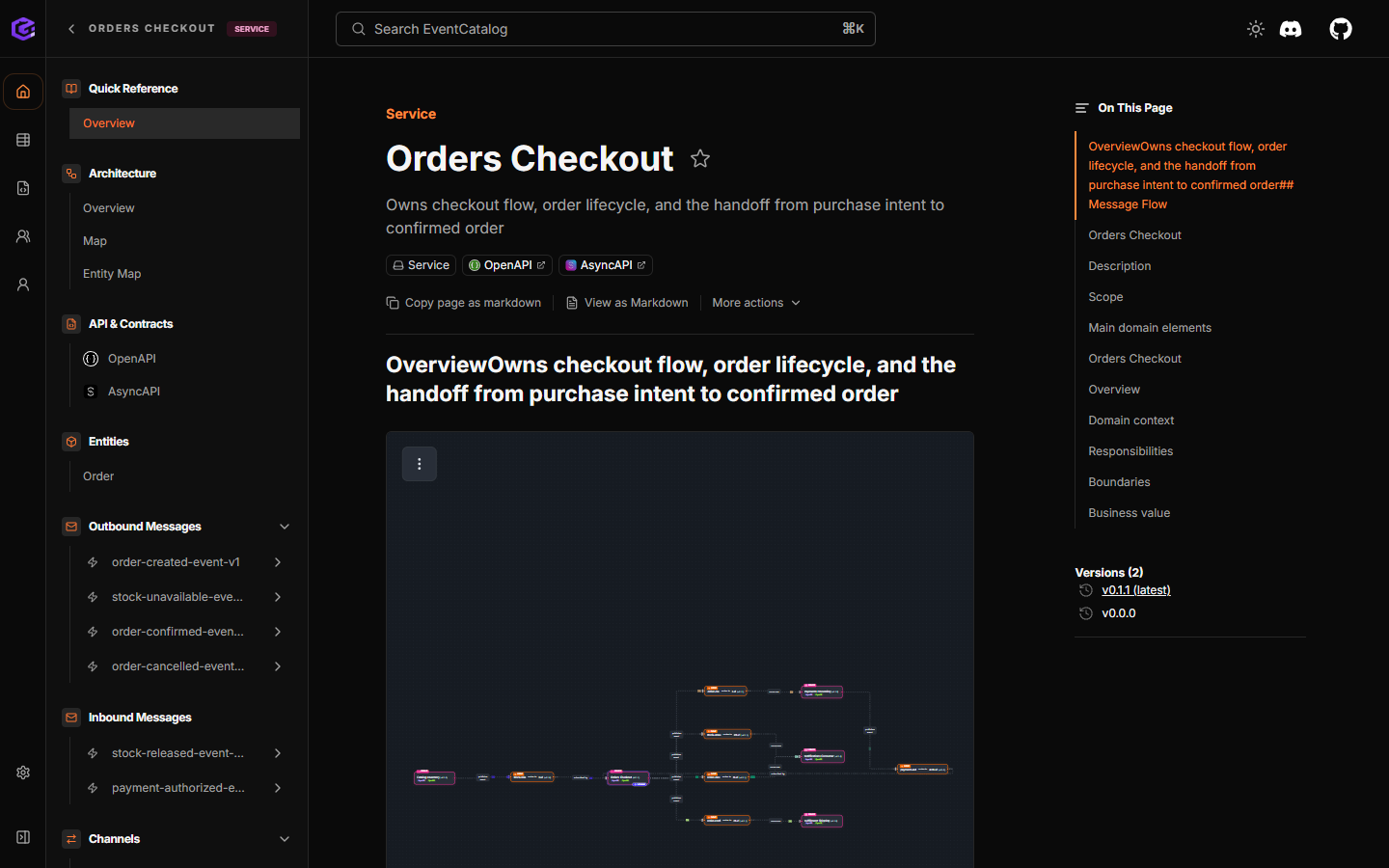
Service specifications in the frontmatter are the asyncapi and openapi artifacts. linkSource decides which resolved URL is written there. In the Arcadia CI run that is Git, so EventCatalog can open the live contracts:
specifications:
- type: "asyncapi"
  path: "https://github.com/arcadia-editions/orders-checkout-api/raw/main/asyncapi.yml"
- type: "openapi"
  path: "https://github.com/arcadia-editions/orders-checkout-api/raw/main/openapi.yml"
The published service page is the result of that projection:
Versions come from the contracts
The manifest carries an artifact version for source resolution. The catalog page version is richer.
The first loaded provider AsyncAPI info.version becomes the service version. OpenAPI can fill it only if AsyncAPI did not. Child pages inherit that service version unless the resource has its own.
That is why Catalog Products is 0.5.0 in the catalog even though the manifest service version is 0.0.0: the generator read version: "0.5.0" from catalog-products-api/asyncapi.yml. Orders Checkout is 0.1.1 for the same reason.
When a later run changes that version, the writer copies the previous page into versioned/{old-version}/ and writes the new current page. Existing versioned/ trees are left alone. Regeneration can wipe generated files without erasing catalog history.
AsyncAPI becomes channels, events, and commands
Only the owned asyncapi artifact is projected as public messaging. asyncapi-client is not a second set of channels. It is consumption evidence, handled later.
For each channel in the provider spec the generator writes a channel page:
{service-id}.{channel-key}Catalog Products declares:
channels:
  product-published-event-v1:
    address: catalog-products.product-published.event.avro.v1
    messages:
      ProductPublishedEvent:
        $ref: "#/components/messages/ProductPublishedEvent"
That becomes:
- Channel
catalog.catalog-management.catalog-products.product-published-event-v1 - Kafka address copied into frontmatter as
address - A message page with the same ID
The message page type is not taken from EventCatalog guesses. zenwave-architecture classifies the channel first:
x-message-type: eventorcommandon the channel or message- Otherwise the channel key:
eventin the name makes an event,commandmakes a command - Otherwise
sendoperations default to event,receiveto command
product-published-event-v1 is therefore an event. A channel named reserve-stock-command would be a command.
Each AsyncAPI operation also fills the owning service’s sends or receives:
action: send→ the service sends that messageaction: receive→ the service receives that message
Catalog Products only sends. Its generated service frontmatter looks like this:
sends:
- id: "catalog.catalog-management.catalog-products.product-published-event-v1"
- id: "catalog.catalog-management.catalog-products.product-retired-event-v1"
If the payload $refs an Avro file, the event page gets a schemaPath and a remote schema viewer pointed at the AsyncAPI URL plus the channel and message names.
OpenAPI becomes commands and queries
Every OpenAPI operation with an operationId becomes a candidate catalog resource:
{service-id}.{operationId}The HTTP method decides the first classification:
GETandHEAD→ queriesPOST,PUT,PATCH,DELETE→ commands
The REST binding is kept on the page:
id: "catalog.catalog-management.catalog-products.createProduct"
name: "createProduct"
operation:
  method: "POST"
  path: "/products"
  statusCodes:
  - "201"
That is the OpenAPI fragment:
paths:
  /products:
    post:
      operationId: createProduct
Arcadia’s published services are command-style APIs, so the live catalog has command pages and no query pages. Add a GET /products/{id} with operationId: getProduct and the generator would write .../queries/{service-id}.getProduct/index.mdx.
ZDL becomes entities and logical operations
ZDL is the domain model. Each entity becomes:
{service-id}.{kebab-case-entity-name}Product in Catalog Products is catalog.catalog-management.catalog-products.product. Order in Orders Checkout is orders.checkout.orders-checkout.order.
The page keeps the modeling facts EventCatalog can render: aggregate root, identifier, properties, enums, and references.
id: "orders.checkout.orders-checkout.order"
name: "Order"
aggregateRoot: true
identifier: "orderId"
properties:
- name: "status"
  type: "OrderStatus"
  required: true
  enum: ["CREATED", "CONFIRMED", "CANCELLED"]
ZDL service methods are also collected as logical operations. They are not automatically catalog pages. They are the stable semantic identity used in the next step.
When REST and AsyncAPI bind to the same operation
A ZDL method, an OpenAPI operation, and an AsyncAPI command channel can describe the same business action. The generator does not merge them by name. It merges them only when the architecture graph has a validated binding from the ZDL method to that transport.
When that happens, the published command or query ID is the logical operation:
{service-id}.{operation-slug}reserveStock stays catalog.inventory-management.catalog-inventory.reserveStock, with the OpenAPI POST /inventory/reservations recorded on the page. The channel key is not the command ID.
If the graph cannot bind a ZDL method to a published contract, the operation stays internal. It can still appear as a blue node in a ZFL flow, linked to its owning service. publishInternalOperations=true is the opt-in that also writes those internal operations as catalog command or query pages.
Unbound AsyncAPI events and unbound REST operations that have no ZDL method still become catalog resources. They are not dropped just because the domain model did not name them.
Consumers connect services without duplicating channels
The manifest consumers list is the declared graph of who talks to whom:
consumers:
  - "payments.payment-processing.payments-processing#asyncapi-client"
  - "fulfillment.shipping.fulfillment-shipping#asyncapi-client"
The generator then matches those client artifacts against the provider AsyncAPI. A verified match does two things:
- The consumer service receives the provider message.
- The event page lists that service under
consumers, with the client operation that matched.
OrderConfirmed is owned by Orders Checkout. Fulfillment Shipping consumes it through its asyncapi-client. The generated event page therefore has:
id: "orders.checkout.orders-checkout.order-confirmed-event-v1"
producers:
- "orders.checkout.orders-checkout-0.1.1"
consumers:
- "fulfillment.shipping.fulfillment-shipping-0.1.0"
Fulfillment does not get a second copy of the channel. The channel stays in the provider subdomain. The consumer relationship is a pointer.
The same match is what fills receives on the consumer service. That is how a service page can show inbound events the service never declared in its own provider AsyncAPI.
ZFL becomes EventCatalog flows
A domain-level zfl artifact is a business narrative. Arcadia keeps Place Order on the architecture domain:
domains:
  "architecture":
    artifacts:
      - type: zfl
        path: "business-flows/place-order-flow.zfl"
        version: "0.0.0"
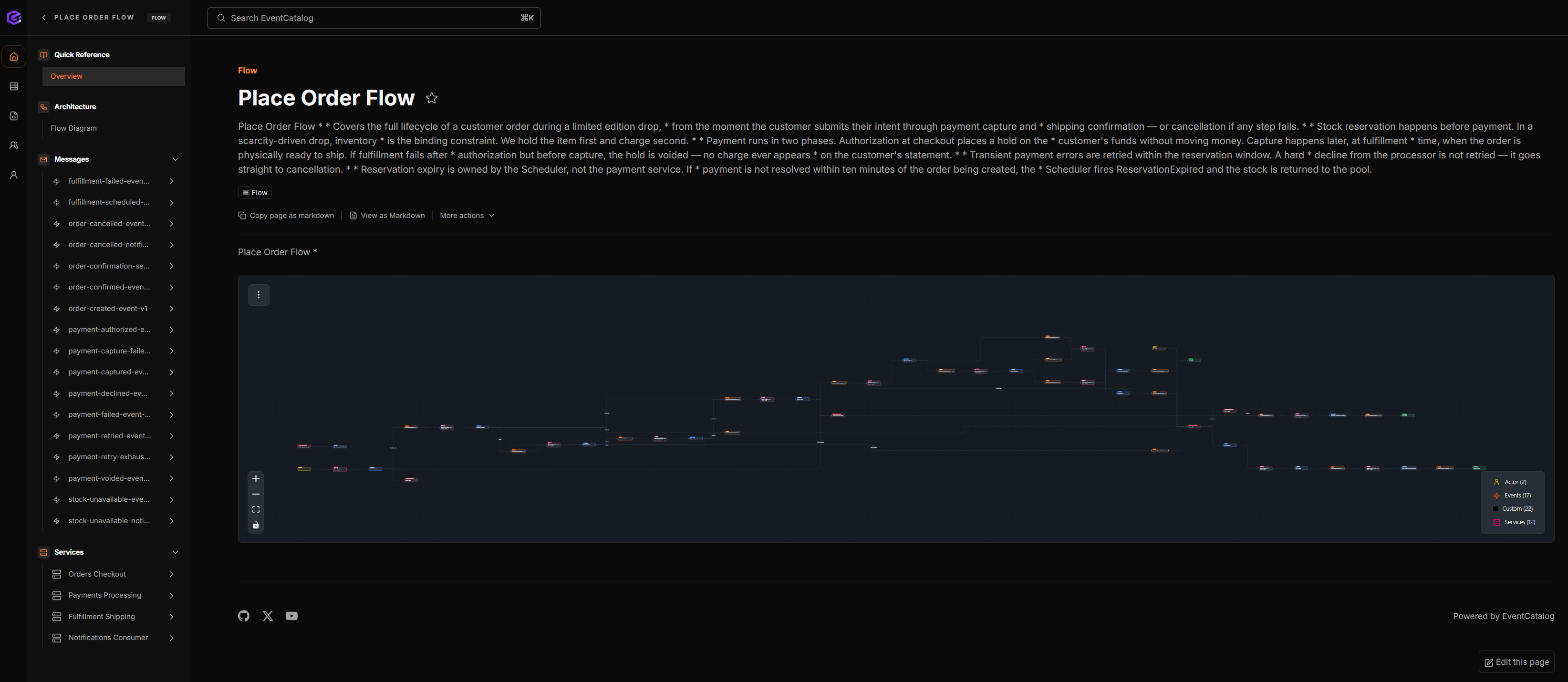
The flow ID is the slug of the ZFL flow name: PlaceOrderFlow → place-order-flow. The page is written at domains/architecture/flows/place-order-flow/index.mdx.
The generator walks the architecture graph, not the raw ZFL text:
| ZFL construct | EventCatalog step |
|---|---|
@actor start | Actor step |
| Timer / scheduler start | Custom timer step |
| Bound command or query | Native message step, clickable into the catalog resource |
| Unbound operation | Blue operation node, linked to the owning service |
| Emitted event that matches a catalog event | Native event message step |
| Unmatched event | Custom event node |
| Flow outcome | End node |
Participating services get a flows pointer back to the same flow. That is why the Orders Checkout service frontmatter includes:
flows:
- id: "place-order-flow"
  version: "0.0.0"
The published flow is the readable version of that graph:
What a run actually writes
Frontmatter is built from typed Java records and serialized as YAML. The MDX body is a Handlebars template. Clients override bodies by copying the same path under .zenwave/templates; they do not template the header.
One Arcadia-sized run produces this layout:
event-catalog-content/
  domains/
    architecture/
      index.mdx
      flows/place-order-flow/index.mdx
    orders/
      index.mdx
      subdomains/orders.checkout/
        index.mdx
        channels/...order-confirmed-event-v1/index.mdx
        services/orders.checkout.orders-checkout/
          index.mdx
          commands/....startOrderCheckout/index.mdx
          events/....order-confirmed-event-v1/index.mdx
          entities/....order/index.mdx
          versioned/0.0.0/index.mdx
The writer deletes generated files first, then writes the new tree, while leaving every versioned/ directory in place.
Closing the loop in CI
Generation is only useful if it is the catalog, not a snapshot someone pasted once.
arcadia-event-catalog keeps the EventCatalog application in site/ and the generated tree in event-catalog-content/. The generator can clean the content folder without touching the app, the workflows, or the lockfile.
scripts/generate-catalog.sh is the whole mapping described above, invoked as:
jbang zw \
  -p io.zenwave360.sdk.plugins.EventCatalogPlugin \
  inputFile=https://raw.githubusercontent.com/arcadia-editions/arcadia-editions-architecture/main/zenwave-architecture.yml \
  preferredSource=git \
  allowFallback=false \
  linkSource=git \
  outputFolder=event-catalog-content
update-catalog.yml runs that script when an API repository dispatches api-updated, or when someone triggers the workflow by hand. It verifies, builds, opens a pull request, merges through main, and publishes the site.
The enforcement loop is the same shape as API First Ops, with a different artifact:
change a contract or the master YAML
  -> regenerate EventCatalog content
  -> review the PR
  -> publish the catalog
The live site is arcadia-editions.github.io/arcadia-event-catalog.
What this is for
The architecture manifest is the index. The contracts remain the source of truth for messages, REST operations, and domain types. EventCatalog is the generated view of that graph: one place to see who owns a channel, who consumes an event, which command a flow invokes, and which aggregate a service writes.
If you want the command, the options, and the template override recipe, use the plugin README. If you want the file that makes this projection possible, start with zenwave-architecture and a zenwave-architecture.yml.